
On May 28, 2025, hundreds of passengers who boarded Delta Flight DL275 in Detroit never made it to Tokyo. Delta flight DL275 diverted LAX mid-route, and the full story behind that decision is something every traveller on that flight deserved to know.
The flight took off from Detroit Metropolitan Wayne County Airport on a scheduled 13-hour journey to Tokyo Haneda. Somewhere over the remote, freezing waters of the Bering Sea, the crew quietly changed course. Five hours later, the plane landed at Los Angeles International Airport, thousands of miles from where passengers expected to be.
If you were on that flight, tracking it online, or simply want to understand what caused the DL275 route change to LAX, this article covers the complete picture in plain language.
What Actually Happened on Delta Flight DL275 Diverted to LAX
Delta Flight DL275 departed Detroit Gate A46 on a scheduled 13-hour flight to Tokyo Haneda Airport. While flying over the Bering Sea, the crew decided to turn the aircraft around. The reason, confirmed by subsequent reports, was a critical engine anti-ice system failure detected at cruising altitude.
During the cruise, flight deck indications alerted the crew to an abnormal condition involving the anti-ice system. While the aircraft remained controllable and stable, continuing across remote regions without full system assurance would have increased operational risk. As a result, the crew elected to divert before entering deeper trans-Pacific airspace.
This is exactly how it’s supposed to work. Aviation safety rules are built around one principle: when there’s any doubt about a critical system over a remote ocean, you don’t push on. You turn around. And that’s precisely what Captain Sarah Mitchell and her crew did — calmly, professionally, and by the book.
Why the Crew Chose LAX, Not Anchorage, Not Seattle
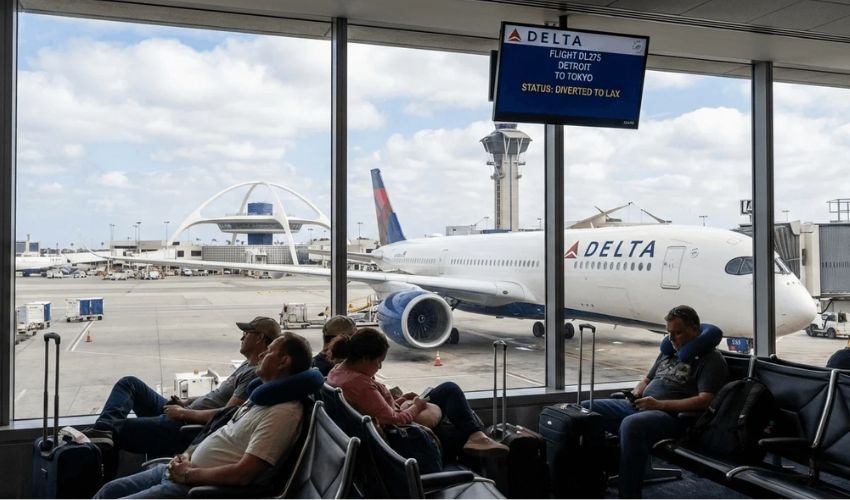
This is the question most passengers and aviation observers asked first: why fly five more hours to Los Angeles when airports like Anchorage’s or Seattle’s are much closer?
Choosing a diversion airport is not simply about distance. Los Angeles International Airport offered the most comprehensive support for both aircraft maintenance and passenger handling. Specifically, LAX is a major Delta hub with on-site maintenance teams, Rolls-Royce-certified specialists, long-haul runway capacity, and the full passenger support infrastructure needed to rebook and accommodate hundreds of international travellers quickly.
Anchorage could land the plane. LAX could fix it, rebook 287 people onto onwards flights, and do it all from a hub where Delta operates daily. That’s the difference – and it’s why the crew and Delta’s operations control centre made the call they did.
The Engine Anti-Ice System: What It Is and Why It Matters
If you’re not an aviation enthusiast, “engine anti-ice system failure” probably sounds technical and alarming. Here’s what it actually means in plain language.
The anti-ice system in a Rolls-Royce Trent XWB engine works by moving heated air across engine parts. This hot air, which usually reaches 400 to 600 degrees Fahrenheit, keeps ice from forming during flight. When you’re flying at 38,000 feet over the Bering Sea in temperatures of -67°F, ice formation on engine components is a genuine risk—one that can affect airflow and engine performance if left unchecked.
The Airbus A350-900 has multiple redundant systems built in, which is precisely why no one was in immediate danger. The failure of one system doesn’t compromise flight safety. The diversion decision was a precautionary measure required by international aviation safety regulations. The aircraft flew safely to LAX under full control throughout. But the rules are clear: if you can’t confirm full redundancy over the remote ocean, you don’t continue. You land.
What Passengers Experienced on Delta Flight DL275
For the 287 people on board, this was not a comfortable night. What began as a long but routine transpacific flight became an unplanned 12-hour journey ending in the wrong city, in the middle of the night, with bags checked to Tokyo and connecting flights already missed.
Passengers on the diverted flight likely experienced announcements from the cockpit explaining the situation as transparently as possible, coordination by cabin crew to ensure passengers remained calm and secure, and extended travel times as the aircraft landed and passengers awaited alternative arrangements.
Social media lit up quickly. Travellers shared videos from inside the cabin and at LAX, describing the mix of anxiety and relief that comes with an unexpected diversion. Most gave the crew and cabin staff credit for keeping the mood calm and communication clear throughout.
How Delta Responded
Delta rebooked 156 passengers on the next DL275 flight departing May 29, 98 passengers on DL295 the same day, and 33 passengers on partner airline flights. All affected passengers were provided with hotel accommodations and meals while they waited. Delta’s official statement confirmed the crew followed standard procedures and that Rolls-Royce specialists were standing by at LAX to inspect and repair the aircraft.
Most passengers reached Tokyo within 48 hours of their original schedule — not ideal, but a reasonable outcome given the complexity of rerouting a full wide-body international flight in the middle of the night. If you ever find yourself in a similar situation and need to quickly rebook or find accommodation during a disruption, TravelTweaks Bookings is a reliable tool for finding available flights and hotels fast.
Read More: Ttweakflight Offers
What To Do When Your Flight Lands in the Wrong City
Incidents like the Delta DL275 diversion are unsettling to read about, but the passengers on Delta Flight DL275 learnt firsthand that it can happen on any flight, on any airline, on any given day.
If your plane ever touches down somewhere other than your intended destination, the first thing to do is stay calm and stay put.
Don’t rush down the aisle; listen carefully to the crew’s announcements, because the information they give in those first few minutes is important. Rebooking options, hotel arrangements, and ground transport are more valuable than anything you’ll find scrolling social media in a panic.
While you’re still in your seat, open your airline’s app and check in directly: many airlines, including Delta, begin automatic rebooking before the plane even reaches the gate, and acting fast on the app often gets you a better option than waiting in the queue at the service desk.
Once you’re off the plane, locate the airline’s customer service counter in the terminal, confirm your rebooking, and ask specifically about meal vouchers and hotel accommodation, as you are entitled to both when a diversion is caused by a mechanical issue. Do keep every receipt for anything you pay out of pocket.
Travel insurance exists precisely for moments like this, covering missed connections, prepaid hotel nights at your destination, and additional expenses that the airline won’t cover.
A disruption like an unplanned landing in LAX instead of Tokyo is stressful, no question but travellers who know their rights, keep their documents accessible, and move deliberately rather than frantically tend to come out the other side with a story worth telling rather than a trip worth forgetting.
What Travelers Are Still Searching About Delta Flight DL275 Diverted LAX
Why was Delta flight DL275 diverted to LAX instead of continuing to Tokyo?
The crew detected a critical failure in the engine anti-ice system while flying over the Bering Sea at 38,000 feet. Aviation safety regulations are clear on this point: when a critical system cannot be fully confirmed over remote ocean airspace, the flight must divert. Continuing to Tokyo would have meant flying deeper into one of the most isolated stretches of ocean on the planet without full system assurance. The crew followed the rules exactly as written and turned toward Los Angeles.
Why did the plane fly five hours to LAX instead of landing at the nearest airport?
Distance alone does not determine where a diverted aircraft lands. Los Angeles International Airport offered something Anchorage and Seattle could not match at that scale: a full Delta hub with Rolls-Royce-certified engineers, Airbus A350 maintenance facilities, and the passenger infrastructure needed to rebook and accommodate 287 international travellers overnight. The crew and Delta operations control made the right call. If you need to rebook quickly during a flight disruption, TravelTweaks Bookings can help you find available flights and hotels in real time.
Was delta flight DL275 diverted LAX a full emergency?
No. The diversion was precautionary, not an in-flight emergency. The Airbus A350-900 remained fully controllable and stable throughout. The anti-ice system failure did not cause engine loss or structural damage. The aircraft landed normally at LAX under complete crew control. The word emergency is often used loosely online, but this was a by-the-book precautionary diversion carried out calmly and professionally.
What is the engine anti-ice system and why does it matter over the Pacific?
The Rolls-Royce Trent XWB anti-ice system circulates heated air across engine components to prevent ice formation at high altitude. At cruising altitude over the Bering Sea, outside temperatures drop to around -67°F. Ice forming on engine parts at that temperature can affect airflow and engine performance.
How long did the delta flight DL275 diversion to LAX take?
The aircraft flew approximately five additional hours after changing course over the Bering Sea. The total journey from Detroit to LAX lasted around 12 hours and 15 minutes. The flight landed at Los Angeles International Airport at 01:08 AM on May 28, 2025.
Was this the fault of Delta Airlines or Rolls-Royce?
No official findings have attributed fault to either party as of the time of writing. Delta confirmed that Rolls-Royce specialists were on standby at LAX to inspect the Trent XWB engine. The investigation into the root cause of the anti-ice system failure was ongoing. What is clear is that the crew response, diversion decision, and passenger handling all met the required standard.